Buyers often say a supplier failed to follow the requirements. Yet when the order history is reconstructed, there may be no single complete version to follow. One decision sits in an email, another in a chat, while dimensions, photographs, sample comments, and quotation notes live in separate files.
A product specification describes the product. A supplier-ready requirement pack also records what has been decided, what is still open, and which version the supplier must use. That same pack supports quotation comparison, sample review, production, and inspection.
If you are still collecting the basic inputs, begin with the Order Requirements Checklist. This guide shows how to turn those inputs into a versioned pack with clear decisions and open questions.
1. Clear Product Requirements Are More Than a Specification Sheet
A completed form does not prove supplier understanding. Even accurate files cause problems when they describe different dimensions, materials, configurations, or revisions. Technical content needs status, version, priority, and approval information beside it.
A supplier-ready product requirement package defines the product, measurable specifications, reference documents, packaging, quality criteria, open decisions, revision status, and supplier deviations in one controlled record.
The quotation, approved sample, production release, and inspection brief should all point to the same product decisions.
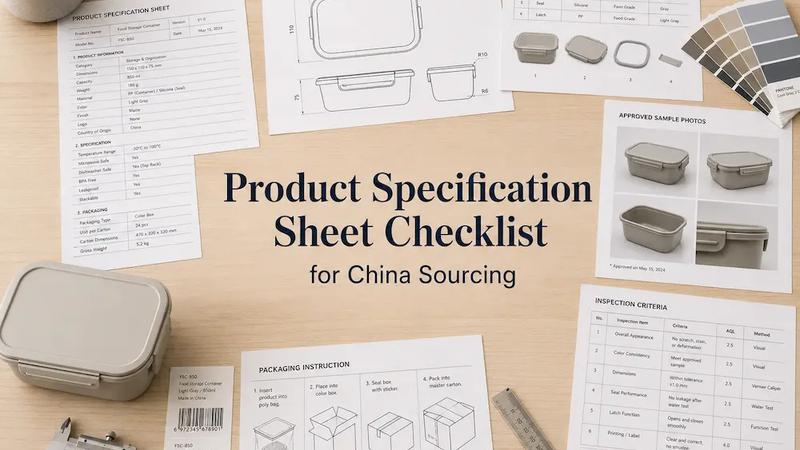
Use the Product Specification Sheet Checklist for China Sourcing to check the technical fields. Then mark the active revision and require the supplier to identify anything it cannot meet.
2. Start With Intended Use and Destination Market
Start with intended use, user, and operating environment. Heat, moisture, repeated loading, installation, storage, or transport conditions may change the material, construction, packaging, or test plan. Name the exact product variant as well as the product family.
The destination market determines details such as voltage, plug, gas type, language, installation, and labeling. Check the actual product and market instead of copying compliance fields from a generic template.
For EU-bound products, use European Commission guidance on identifying applicable CE-marking requirements 1 to determine whether relevant legislation applies; not every product requires CE marking. Where technical documentation is required, EU guidance on preparing product technical documentation 2 shows why design, manufacture, operation, test evidence, and compliance records need to align.
The brief should name who identifies applicable rules, arranges tests, and supplies reports or declarations. Product-specific legal, regulatory, certification, or engineering review remains a separate responsibility.
3. Separate Required, Preferred, Flexible, and Open Requirements
Add a status beside every requirement. It tells the supplier whether to comply, propose an alternative, or wait for a decision. Without that status, a preference may be treated as mandatory while an open item disappears from the quotation.
| Status | Meaning | Supplier action |
|---|---|---|
| Required | The product cannot be accepted if the requirement is not met. | Quote on this basis or state clearly that it cannot be achieved. |
| Preferred | This is the buyer’s first choice, but a controlled alternative may be considered. | Quote the preferred option. Present any alternative separately and wait for written approval. |
| Flexible | The detail may be adjusted for cost, MOQ, manufacturing process, or availability. | Explain the proposed option and its commercial or technical effect. |
| Open | The buyer has not made the final decision. | Keep it visible as unresolved and state when the decision is required. |
“Preferred” is often the most misunderstood status. It does not mean “use something similar if convenient.” A useful entry reads: “Preferred material: 304 stainless steel. If unavailable or materially more expensive, quote the alternative separately. Do not substitute without written approval.”
The word “preferred” does not say which alternatives are acceptable or who approves them. Add a substitution rule and an approval rule. For flexible items, require the supplier to show the effect on price, MOQ, tooling, lead time, performance, or appearance.
4. Define the Product, Variants, and Included Items
Give the product a stable identity using the product name, buyer SKU, supplier model, version, and variant. List applicable size, color, material, voltage, plug, gas, language, and market variants. If one supplier model covers several configurations, add a buyer-controlled configuration code.
List everything supplied with the main product, including standard components, optional accessories, spare parts, tools, manuals, cables, and plugs. State the quantity per set, retail unit, or carton. “Complete set” means little unless the contents are named.
For example, a base machine, the same machine with an optional attachment, and the base machine purchased alongside a separate automatic machine are three commercial configurations. Each needs its own inclusions and price. The quotation must show exactly which configuration it covers.
Suppliers can only be compared when they price the same configuration. The Pricing, MOQ & Quotation Guide explains the commercial fields to compare, but comparison only works when each supplier is pricing the same product and included items.
5. Replace Vague Wording With Measurable Requirements
Vague language transfers decisions to the supplier. Replace each vague term with a number, range, named reference, test method, or observable pass/fail result appropriate to the product. Do not copy invented universal tolerances or test values into a brief.
| Vague wording | Measurable direction |
|---|---|
| Good stainless steel | State the stainless-steel grade, nominal thickness, finish, and acceptable variation. |
| About 100 mm | State 100 mm, define the measurement points, and add the agreed tolerance. |
| Same as the photo | Identify the exact visual features controlled by the photograph. |
| Strong carton | Define construction, dimensions, packed weight, protection method, and any required test. |
| High quality | Define workmanship defects, functional checks, and acceptance criteria. |
Use the same approach for materials, dimensions, measurement points, weight, capacity, color, finish, workmanship, function, and tests. If a value is unknown, label it Open and give it a decision deadline instead of writing “standard” or “normal.”
6. Control Drawings, Photos, Samples, and Written Specifications
Each reference needs a defined job. Drawings may control dimensions, geometry, interfaces, or construction. Photographs show selected visual details, while samples represent only the features that were actually approved. Written specifications record requirements, exceptions, and decisions. Marked-up images can point to an exact area without replacing the specification.
The supplier should not be expected to decide which conflicting reference is correct.
When a written specification, drawing, photograph, or sample conflicts, we review the communication history to determine which reference reflects the buyer’s latest confirmed intent. Once the conflict is resolved, issue a revised controlled document. Do not expect the factory to keep interpreting historical chat messages.
A document-priority statement might say, “Unless a later approved revision states otherwise: 1. approved final specification; 2. approved drawing; 3. approved sample record; 4. numbered visual references; 5. informal communication.” The order can vary by project, but write it down before the files conflict.
7. Treat Packaging, Labels, Manuals, and Accessories as Product Requirements
Packaging is part of the supplied product. Specify the unit pack, inner pack, outer-carton construction and dimensions, quantity, packed weight, protection, and shipping marks. Include barcode data and placement, labels, manuals, warning text, languages, accessories, spare parts, cables, plugs, and tools.
In our sourcing work, packaging, labels, manuals, barcodes, and included accessories are normally recorded before production rather than left until shipment. Artwork can remain Open during early quotation, but ownership, format, approval, and production deadlines must be visible.
When defining barcode location, size, and the conditions under which it must scan, consult GS1 guidance on barcode size, placement, and scanning conditions 3 .
8. Decide When Bilingual Specifications Are Necessary
Not every order needs a bilingual specification. A reviewed bilingual version is more useful for customized products, technical fabrication, structural-steel work, buyer-language drawings, or instructions that factory engineers, production staff, and welders must read directly. It also helps with complex processing, welding, assembly, installation, or packaging instructions.
For customized technical products, a reviewed bilingual specification can help factory teams understand the customer’s drawings and instructions. For standard non-custom products, English supported by images, model references, dimensions, quantities, and unambiguous data may be sufficient.
An inaccurate translation can create a new conflict. Bilingual documents must still be technically reviewed, and both language versions need an agreed priority if wording differs.
9. Keep Open Questions Visible and Close Them at the Correct Stage
An open item is not a forgotten item. It must have an owner, a decision date, and a production consequence. Keep open decisions in the controlled record instead of a separate chat list, and show the stage at which each decision becomes blocking.
| Stage | Must be known or closed | May remain open |
|---|---|---|
| Before quotation | Intended use; core configuration; main dimensions or capacity; core material; target quantity; market configuration; customization; major accessories. | Final color code; some non-critical brands; optional accessories; final artwork; barcode or label content; proposed alternative processes. |
| Before sampling | Sample configuration; key materials; main dimensions; appearance; functional target; included accessories; items the sample must verify. | Only items that do not affect what the sample is intended to prove. |
| Before deposit or bulk-order confirmation | Final configuration and quotation inclusions; quantities and models; packaging, label, and manual responsibilities; lead time; tests or documents; sample approval; final specification revision. | No item that changes price, configuration, responsibility, or the production basis. |
| Before mass production | Final drawings and specification; substitute materials; artwork; packaging; production revision; defect classification; AQL or inspection requirements; obsolete-file status. | No unresolved item that factory teams must interpret during production. |
For each open item, record the options, owner, supplier input, due date, and consequence of delay. Suppliers can then quote before every minor detail is final without filling gaps with their own assumptions.
10. Confirm Quality and Inspection Criteria After Sample Approval
In our workflow, we use this sequence: Initial requirements → Sample development → Sample approval → Final production specification → AQL and defect classification → Bulk order. The approved sample establishes what the product should be, so deviations, defect examples, and functional checks can be written against something specific.
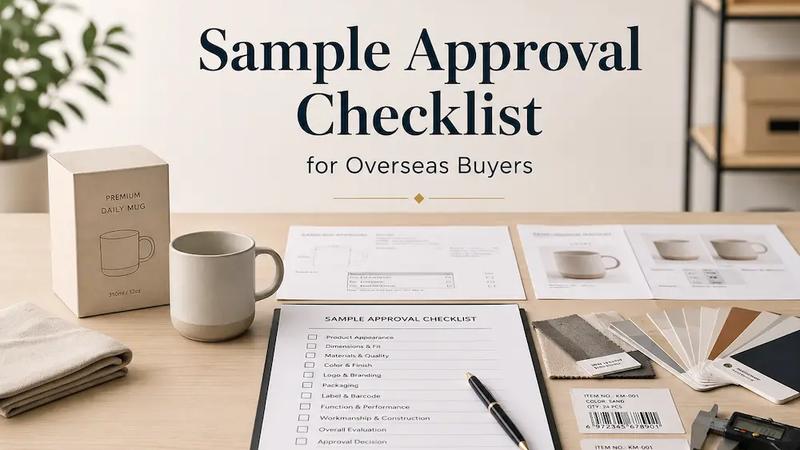
Use the Sample Approval Checklist for Overseas Buyers to record what the sample verified and what remains different from bulk production. When placing the bulk order, confirm the applicable defect categories, test methods, inspection instructions, and sampling plan. These standards should not be discussed for the first time when the inspector arrives.
Where acceptance sampling is appropriate, ISO 2859-1 acceptance-sampling procedures indexed by AQL 4 provides a standards reference. Buyers still need an inspection plan and defect categories suited to their product and risk. AQL does not guarantee quality, and safety, legal, regulatory, or compliance-critical failures may need to be defined earlier.
11. Require the Supplier to Restate and Mark Differences
Step 1 — Restate the requirement
Ask the supplier to restate the configuration, materials, dimensions, accessories, packaging, and unresolved points. Differences in interpretation are easier to fix before sampling or production.
Step 2 — Highlight deviations
Ask the supplier to mark unavailable requirements, substitute materials, differences from the sample or reference, excluded quotation items, and changes affecting price, MOQ, tooling, or lead time. “Highlight differences in red” is a practical visual instruction, but do not rely on color alone. Add a written deviation label or note that remains understandable when printed in grayscale.
Step 3 — Sign or stamp the controlled version
The signed or stamped version should identify the basis for quotation, sample, production, and inspection. A reply that only says “received” leaves the interpretation untested. The useful evidence is the supplier’s restatement and its list of deviations, not the stamp by itself.
12. Synchronize Requirement Changes With Commercial Documents
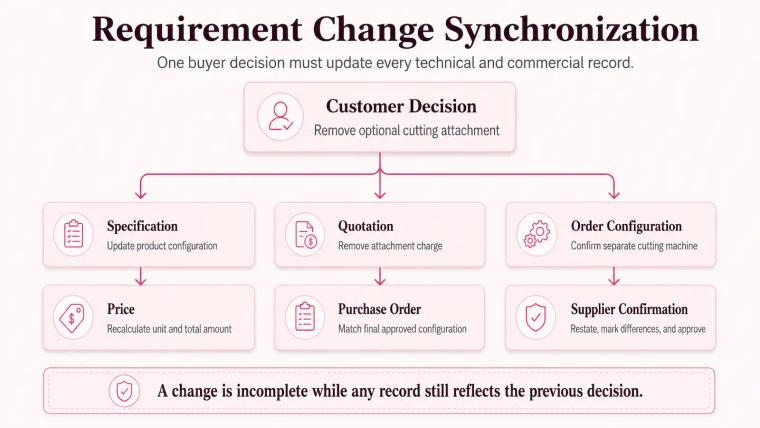
A change is not complete until the specification, quotation, order configuration, price, and supplier confirmation all reflect the same decision.
Update every affected record: specification, quotation, configuration, accessories, price, purchase order, sample record, production instruction, and inspection brief. Name the changed field and its effect instead of relying on the supplier to notice a new attachment.
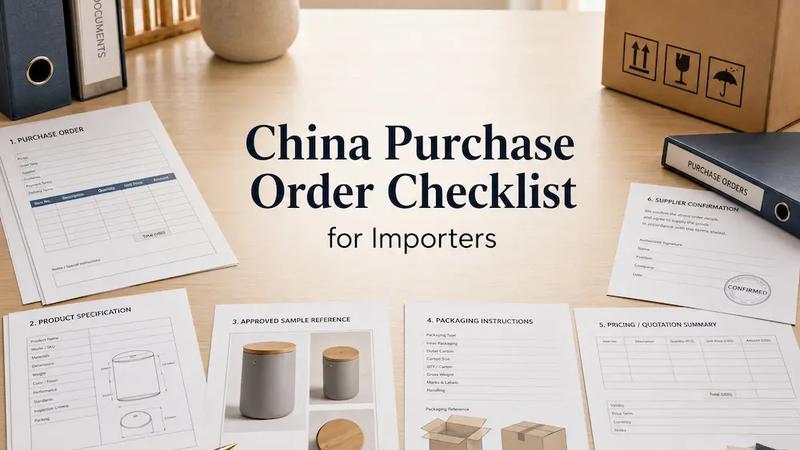
The final approved requirements must connect to the commercial order. Use the China Purchase Order Checklist for Importers to verify that the purchase order points to the active specification, correct configuration, included items, and agreed price.
13. Establish One Controlled Source of Truth
The requirement record needs a title, product codes, revision, issue date, status, owner, approver, and change summary. Link the active drawings and images, then record sample status, open questions, supplier deviations, and obsolete files.
Useful statuses include Draft, For Quotation, For Sample, Approved for Production, and Obsolete. A new revision is not controlled merely because it has been sent. The previous revision must also be clearly withdrawn or marked obsolete. Ask the supplier to confirm which file production and QC can access.
For example: Rev 0, initial quotation requirements; Rev 1, changed dimensions and added packaging details; Rev 2, removed an optional attachment and updated the quotation configuration. This is an illustrative history, not the revision record from the dough-sheeter case.
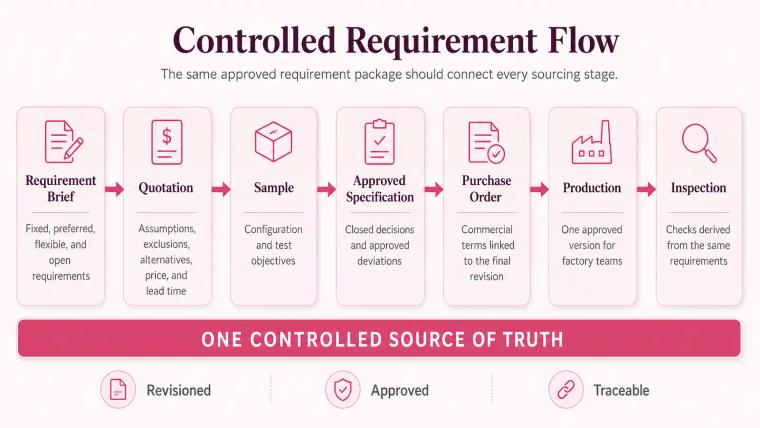
14. Use the Same Requirement Package Throughout the Order
Use one controlled sequence: Supplier inquiry → Quotation comparison → Sample request → Sample approval → Purchase order → Production release → Inspection brief. This requirement record sits inside the wider process described in How to Source Products from China Step by Step.
- Supplier inquiry: initial required, preferred, flexible, and open requirements.
- Quotation: supplier assumptions, exclusions, alternatives, MOQ, price, and lead time.
- Sample: the specific configuration and test objectives the sample must prove.
- Sample approval: approved features, approved deviations, and closed open items.
- Purchase order: commercial terms linked to the final controlled specification.
- Production release: one approved version issued to the relevant factory teams.
- Inspection brief: checks derived from the same approved requirements and sample record.
Later stages can add detail, but they should not create a separate specification that contradicts the approved pack. If a decision changes the product or commercial basis, revise the source record first and update every affected document from there.
Common Mistakes When Sending Product Requirements
- Requirements are divided among chat messages, emails, spreadsheets, and images.
- Required and preferred items are not distinguished.
- Preferred items do not include an alternative or approval rule.
- The brief says “same as photo” without identifying which features the photo controls.
- Drawings, samples, and written specifications conflict.
- A product change is made without updating the quotation or order price.
- Only the salesperson confirms the requirement; engineering or production teams do not review it.
- A new file is issued without withdrawing the old version.
- Defect standards are defined only immediately before inspection.
A Supplier-Ready Product Requirement Template
Use the groups below as a working template. Keep only the fields that apply. If a decision is unresolved, label it Open, assign an owner, and set a deadline.
Requirement package groups
Product identity
- Product name
- Buyer SKU
- Supplier model
- Version or variant
- Intended use
- Destination market
Requirement status
- Required specifications
- Preferred specifications
- Flexible items
- Open questions
- Decision deadlines
Technical requirements
- Material
- Dimensions and tolerances
- Color and finish
- Function
- Test method
- Acceptance result
References
- Drawings
- Numbered photos
- Sample references
- Reference priority
- Revision numbers
Included items
- Accessories
- Spare parts
- Tools
- Cables
- Manuals
Packaging and labeling
- Unit packaging
- Carton
- Quantity per carton
- Barcode
- Label
- Shipping marks
- Artwork status
Compliance and quality
- Destination-market requirements
- Testing responsibility
- Reports or documents
- Sample approval
- Defect classification
- AQL or inspection plan
Supplier response
- Assumptions
- Exclusions
- Alternatives
- Deviations
- Effect on MOQ, price, tooling, and lead time
Control
- Document owner
- Revision
- Issue date
- Approval
- Obsolete files
Final Check Before You Send the Requirement Brief
- Has every vague term been replaced by a number, range, reference, test, or clear example?
- Are required, preferred, flexible, and open items identified?
- Does every preferred item include an alternative and approval rule?
- Are all open questions visible with a decision deadline?
- Does each drawing, image, and sample have a defined role?
- Is there one controlled revision?
- Have old files been withdrawn?
- Does the quotation cover the final configuration?
- Has the supplier restated the requirement?
- Have all differences and exclusions been marked?
- Is the requirement ready to support sample approval, production, and inspection?