Sourcing from China involves a sequence of commercial commitments. The buyer shares a requirement, invests in samples, selects a supplier, pays, releases production, accepts goods, and hands the shipment to the logistics chain.
A supplier profile does not approve a factory. A good sample does not prove that bulk production will match it, and an inspection cannot guarantee every unit. Each commitment settles one question while leaving others open.
The rule is simple: do not move to the next commercial commitment until the decision, evidence, record, stop condition, and remaining risk are visible.
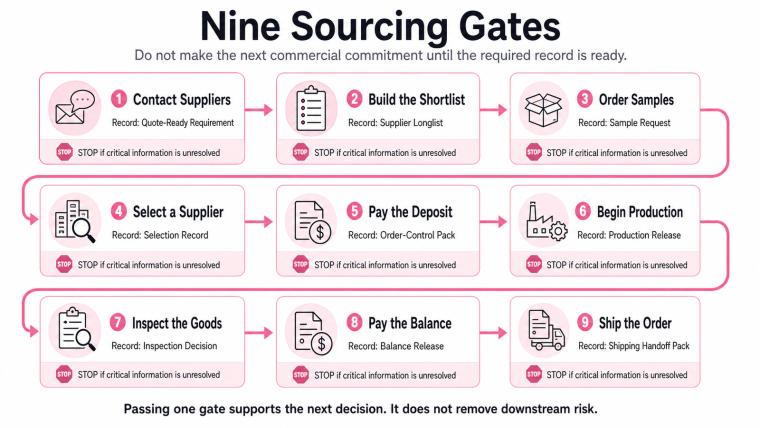
The thirteen stages below lead to nine formal gates. They also keep supplier verification, factory audit, sample approval, testing, production follow-up, and pre-shipment inspection separate. These activities may support one another, but they answer different questions.
1. Define the sourcing objective
Start with what the project must achieve. Define the product’s use, destination market, sales channel, quantity scenarios, target-cost logic, schedule, and non-negotiable features. Separate fixed requirements from points that may change after supplier input.
The destination market matters from the start because product requirements, labeling, packaging, conformity assessment, duties, origin rules, and customs procedures vary. The European Commission’s Access2Markets portal illustrates this for goods entering the EU, but buyers should consult the relevant official authority for their product and destination. 1 A supplier’s previous export experience does not settle the buyer’s compliance obligations.
Address intellectual property at this stage as well. Identify buyer-owned brand assets, artwork, drawings, molds, software, or other information that needs control. Decide what suppliers need for quotation and what can wait until the shortlist. This is an information-control step, not a legal conclusion about a particular market.
- Decision: Is the project defined well enough to justify supplier search?
- Evidence: Product use, market, quantity scenarios, commercial constraints, schedule, and critical risks.
- Record: A sourcing objective and initial risk profile.
- Stop or delay: Product use, destination, critical requirements, or budget logic remains too unclear.
- Residual risk: The market may change, and suppliers may expose requirements that were not visible at the start.
2. Build a quote-ready requirement
A photograph, catalogue link, or broad product name is not enough for a comparable offer. Give several suppliers the same controlled requirement.
Include function, materials, dimensions, tolerances, finish, color, components, performance criteria, packaging, labels, artwork, manuals, quantities, and any testing or documentation questions. Use drawings, reference images, or an existing sample where they improve clarity. Mark each file with a version and date.
For steel-related products, similar descriptions may hide different dimensions, thicknesses, weights, tolerances, or measurement assumptions. State whether an important value is nominal, minimum guaranteed, subject to a tolerance, or measured by an agreed method. Apply the same discipline whenever a small specification difference can change cost or performance.
Do not approve a product from polished catalogue images alone. Ask for current real-product images when relevant, and use physical samples where the decision requires them. The product-requirements guide provides a fuller structure.
- Decision: Can suppliers quote and discuss one controlled requirement?
- Evidence: Measurable product, packaging, documentation, and acceptance inputs.
- Record: A versioned, quote-ready requirement pack.
- Stop or delay: Load-bearing details are missing, contradictory, or unmeasurable.
- Residual risk: Suppliers may still interpret an input differently, so their assumptions must be recorded.
3. Choose the sourcing route
There is no single best sourcing channel. Route selection depends on the product, stock or custom status, order size, technical complexity, communication and export-document needs, local support, and the consolidation plan.
Alibaba.com is an international B2B search and transaction channel. For Trade Assurance, Alibaba says protection rests on the online order, agreed product quality and ship date, payment path, evidence, and platform rules. 2 It does not automatically guarantee performance or a full refund. Alibaba Group describes 1688 as a domestic wholesale marketplace in China. 3 A 1688 listing price is not a normalized export offer. Packaging, export handling, documentation, domestic transport, payment, inspection cooperation, and shipping handoff still need review.
Made-in-China provides international search tools and Audited Supplier reports. 4 Global Sources combines online discovery with face-to-face sourcing channels. 5 The Canton Fair supports exhibitor and product search, sourcing requests, matching, quotations, communication, and buyer attendance. 6 All three provide leads and screening inputs, not supplier approval.
Kelsy uses combinations of Alibaba, 1688, industry exhibitions, referrals, Chinese manufacturing clusters, and recommendations from existing suppliers. In Kelsy practice, a 1688 search may start in a relevant manufacturing cluster, expand geographically if necessary, and move to Alibaba if no suitable supplier is found. Guangzhou exhibitions also help Kelsy build a long-term supplier resource pool. This is Kelsy’s practice, not a universal route.
Sourcing-route decision table
| Route | Useful when | Buyer resources required | Evidence available | Common limitation | Next verification step |
|---|---|---|---|---|---|
| Alibaba | International search and platform-based transactions are useful | Clear requirement and ability to compare suppliers | Profiles, responses, platform orders, and some assessment reports | Listings and protection do not prove order performance | Read reports; verify entity, offer, and order evidence |
| 1688 | Domestic-market supply may fit the product | Chinese-language and local coordination capability may be needed | Listings, company information, catalogues, and supplier responses | Export offer and handoff may not be defined | Normalize export, payment, document, inspection, and logistics terms |
| Made-in-China | Another international supplier pool is useful | Ability to read audit-report scope | Profiles, inquiries, and Audited Supplier reports | Audit mark is not order-specific capability evidence | Check report company, site, date, scope, and current relevance |
| Global Sources | Online search and face-to-face contact both fit | Structured follow-up after initial contact | Supplier listings, inquiries, catalogues, and event contact | Verified and unverified listings still require buyer review | Build an evidence-based shortlist |
| Canton Fair or industry show | Physical product review and technical discussion help | Travel or event participation, plus follow-up capacity | Booth contact, product observation, discussion notes | Booth presence does not establish legal or production facts | Record the lead; request company and site evidence |
| Referral | A trusted contact can introduce a relevant supplier | Independent review despite the introduction | Referral context and supplier response | The referrer’s experience may not match the current order | Apply the same verification and sample gates |
| Sourcing agent | The buyer needs local search, communication, or coordination | A defined scope, reporting expectations, and decision ownership | Search records, comparisons, local evidence, and follow-up | Agent involvement does not remove buyer or supplier risk | Define authority, deliverables, fees, and escalation rules |
| Trading company | Product range or coordination may be valuable | Transparency about role and supply chain | Commercial offer and coordination evidence | Production-site access or process control may be indirect | Verify contracting role, source, controls, and responsibilities |
| Direct factory | Process access and a focused product fit matter | Ability to manage technical and commercial coordination | Site, process, sample, and production evidence | A factory is not automatically the best commercial fit | Verify entity, capability, capacity, and order controls |
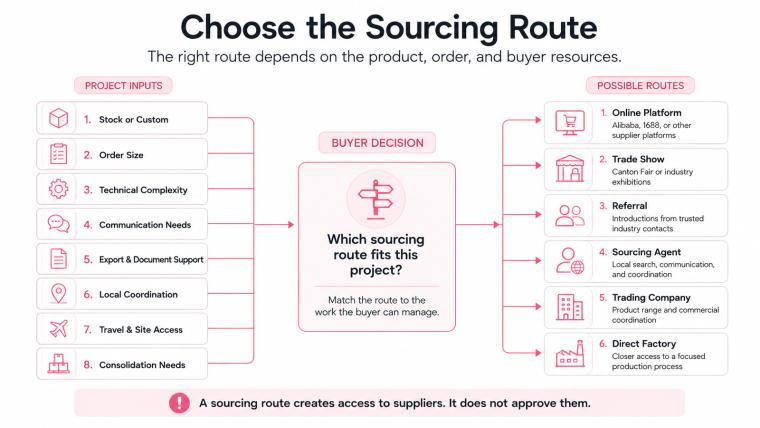
A visit to China can improve product review and discussion, but it does not replace structured evidence. Plan the questions, sites, and records to review. Before committing, verify the entity, production site, capability, and offer.
- Decision: Which channel mix fits this product and the buyer’s resources?
- Evidence: Product type, customization, communication, export, documentation, travel, and consolidation needs.
- Record: A channel strategy and supplier-search criteria.
- Stop or delay: The route cannot support necessary communication, evidence, export, or coordination work.
- Residual risk: A suitable search channel can still produce an unsuitable supplier.
4. Build and screen the supplier pool
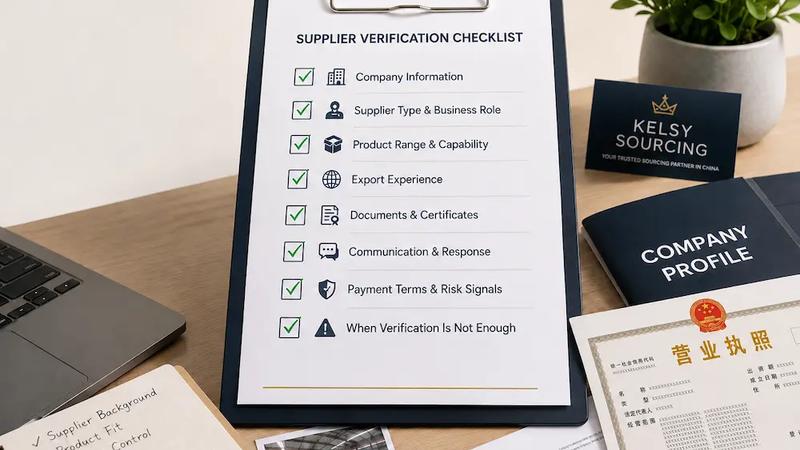
Send the same requirement and initial questions through each channel. Record the company name, claimed role, product fit, location, catalogue range, initial answers, quotation completeness, and available evidence. A supplier-search checklist keeps exclusions and follow-up consistent.
Before deeper review, Kelsy commonly asks for a business licence, factory video, and product catalogue. Kelsy also uses public company records, business scope, whether the registered activity appears connected to manufacturing, an industrial-area versus office-building address, factory videos, and unplanned video calls requesting a live factory view. These items can support screening; none proves that the supplier is a factory or can perform the order. Immediate acceptance of a live factory call provides useful site evidence, but it is still only one piece of the record.
A trading company may be a good fit when coordination, product range, communication, or order handling matters. Its role alone is not a reason to reject it. Nor should a manufacturing claim be enough for approval. The buyer still needs to know which entity will contract, which site will produce, who controls specifications and changes, and who is responsible for nonconforming goods.
- Decision: Which leads justify verification and quotation work?
- Evidence: Identity, role, product fit, site clues, catalogue, initial answers, and disclosure quality.
- Record: A longlist with evidence status and exclusion reasons.
- Stop or delay: Material identity or product mismatch, unacceptable communication gaps, or refusal to define the offer.
- Residual risk: A screened lead is neither verified nor approved.
5. Verify the shortlist
Verification tests whether the evidence consistently supports the supplier’s identity, role, site, and relevant capability. Review the legal company name, registration, business scope, contracting entity, proposed beneficiary, address, and production-site information. Then assess the product and process evidence needed for this order.
Platform badges can point to evidence, but the report matters more than the logo. Alibaba describes Verified Supplier as involving third-party on-site verification and an assessment report. 7 Made-in-China says its Audited Supplier program provides third-party audit reports. 4 Check the company, site, date, scope, processes, and assessed capability, then confirm that the record applies to the entity and order under review.
Kelsy normally requests certification and test reports after the quotation and product direction are understood. At that point, check the product identity, standard, market, issuer, date, and report scope rather than accepting a certificate title alone.
For a larger commitment—especially with a new supplier, customized product, critical process, or material uncertainty—Kelsy normally recommends reviewing whether a factory audit is justified. An existing professional audit report may be useful, but its company, site, date, scope, process, and current relevance still need review.
- Decision: Is the evidence strong enough to rely on this supplier for the next commitment?
- Evidence: Registration, entity relationships, site and process evidence, relevant reports, and proportionate audit findings.
- Record: A verified shortlist with limitations and open questions.
- Stop or delay: Legal or payment mismatch, critical capability not verified, out-of-scope evidence, or unresolved inconsistency.
- Residual risk: Verification is bounded by the evidence and date; it does not prove shipment quality or future performance.
6. Compare the complete commercial offer
Unit price is only one field. To compare complete supplier quotations, use the same requirement version and quantity scenario for each supplier. Include MOQ, sample and freight costs, tooling, customization, packaging, labels, artwork, testing, carton data, domestic transport, lead-time trigger, payment milestones, validity, exclusions, and change effects.
Ask suppliers to state the named Incoterm, named place or port, and Incoterms® 2020. ICC explains that Incoterms allocate specified obligations, costs, and risks between seller and buyer. They do not replace the sales contract’s payment or quality terms, determine title, or provide governing law or dispute resolution. 8 Keep those subjects explicit in the order agreement.
Complete commercial-offer comparison
| Comparison field | Supplier A | Supplier B | Supplier C |
|---|---|---|---|
| Requirement and version quoted | |||
| Unit price, currency, and quantity scenario | |||
| MOQ and MOQ basis | |||
| Sample fee and freight | |||
| Tooling, mold, fixture, or setup | |||
| Material, dimensions, tolerances, finish | |||
| Packaging, labels, artwork, inserts, manuals | |||
| Testing or report evidence included/excluded | |||
| Incoterm, named place/port, and version | |||
| Carton quantity, dimensions, net/gross weight | |||
| Domestic transport or warehouse delivery | |||
| Lead-time start trigger and milestones | |||
| Payment milestones and release conditions | |||
| Offer validity, exclusions, and assumptions | |||
| Change effect on cost and timing | |||
| Unresolved questions |
Price, MOQ, payment, and timing are project-specific. Ask what drives each term, what it includes, which event starts the schedule, and what evidence supports each release. A universal benchmark will not answer those questions.
- Decision: Which offer is complete, comparable, and commercially suitable?
- Evidence: Normalized technical, commercial, payment, and delivery fields.
- Record: A quotation matrix and documented selection rationale.
- Stop or delay: Different specifications were priced, exclusions remain unknown, or total commitment cannot be compared.
- Residual risk: A complete quotation still does not prove production performance.
7. Develop and approve the sample
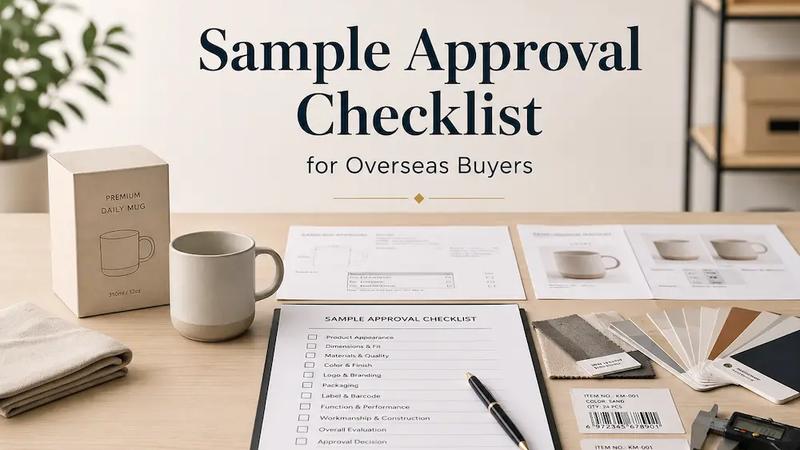
Be clear about what the sample must answer, whether appearance, dimensions, material, function, packaging, artwork, or another acceptance point. Identify its requirement version, source, date, and revision. Record measurements, images, functional observations, deviations, and required changes.
The fields most easily missed when moving from sample to production are material, color, packaging, dimensions, and instructions or manuals. In Kelsy practice, every accepted sample change must be transferred into the controlled bulk-production requirement. Do not let an approval in chat silently replace the specification, artwork, packaging file, or sample record.
Where laboratory testing is required, define the characteristic, method, submitted item, and report scope. The result applies to that sample and method; it does not prove every production unit or the whole factory.
Use a retained reference or an agreed visual and measurement record when practical. The sample-approval checklist can structure this handoff.
- Decision: Is the product reference ready to control bulk production?
- Evidence: Sample identity, measurements, function, materials, finish, packaging, artwork, and required test evidence.
- Record: A signed or date-controlled approval or revision record.
- Stop or delay: A non-negotiable fails, the version is unclear, a change is unconfirmed, or required testing is incomplete.
- Residual risk: An approved sample does not prove bulk consistency, capacity, or schedule.
8. Confirm supplier and order controls
Before placing the order, assemble the supplier evidence, approved sample, final requirement, quotation, purchase order or contract, payment instructions, production-site and subcontracting details, inspection plan, change rules, and responsibilities for nonconforming goods.
Three premature decisions matter here: confirming an order without sufficient supplier and order review; approving polished catalogue images without checking current real-product images or samples; and paying before confirming the factory, contracting entity, receiving account, and financial risk.
Do not assume one control replaces another:
Activity-boundary table
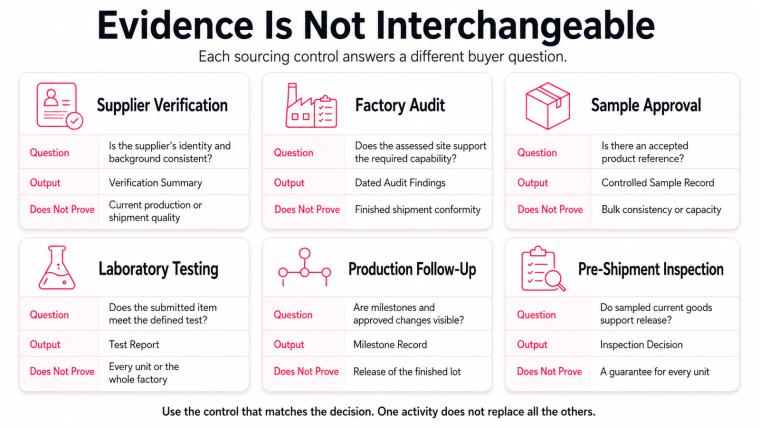
| Activity | Decision supported | Evidence examined | Output | What it cannot prove |
|---|---|---|---|---|
| Supplier verification | Is identity and background sufficiently consistent? | Registration, entities, addresses, role, reports, site evidence | Verification summary and open issues | Current production or shipment quality |
| Factory audit | Does the assessed site/process support a capability decision? | Site, process, systems, records, and scoped objective evidence | Dated audit report and findings | Finished shipment conformity or future performance |
| Sample approval | Is there an accepted product reference? | Identified sample, measurements, function, appearance, packaging, revision | Controlled approval or revision record | Bulk consistency or capacity |
| Laboratory testing | Does the submitted item meet defined characteristics under a method? | Submitted item, method, results, and report scope | Test report | Every unit, the whole lot, or factory capability |
| Production follow-up | Are milestones, changes, and open actions visible? | Order-specific status, materials, measurements, tests, changes, corrections | Milestone and change record | Release of the finished lot |
| Pre-shipment inspection | Do sampled current goods support release, rework, recheck, or hold? | Current lot, controlled criteria, sampled checks, packaging and labels | Inspection report and release decision | A complete guarantee for every unit or later order |
ISO conformity-assessment guidance treats auditing, inspection, and testing as distinct techniques that may be combined. 9 Audit 10 and inspection evidence 11 is scoped and bounded.
- Decision: Is the supplier and order ready for financial commitment?
- Evidence: Final entities, baseline, order terms, roles, change control, quality activities, and release conditions.
- Record: A complete order-control pack.
- Stop or delay: Contracting and beneficiary details conflict, a critical requirement is open, or responsibility is unclear.
- Residual risk: Written controls support decisions but do not guarantee performance or recovery.
9. Pay and launch production safely
Before paying, confirm the contracting entity, invoice issuer, beneficiary name, bank details, payment channel, amount, currency, milestone, and release condition. Keep the verification and payment records in the order-control pack.
If the supplier requests a beneficiary or bank-account change, Kelsy practice is to stop payment; verify by telephone or video through a known contact channel; request signed and company-stamped confirmation; compare the contracting entity, beneficiary, account details, and stated reason; and retain the verification record. This aligns with FBI IC3 guidance to verify account-information changes through a secondary channel 12 . It does not guarantee recovery after a transfer.
If using Alibaba Trade Assurance, ensure the load-bearing specification, packaging, delivery terms, and evidence requirements are in the online order and follow the platform payment process 2 . Do not rely on off-platform messages to carry terms that should control the transaction.
- Decision: Is payment justified and is production ready for formal release?
- Evidence: Verified beneficiary, controlled terms, approvals, release inputs, and applicable platform order.
- Record: Payment record and production-release authorization.
- Stop or delay: Unexpected account change, incomplete approval, conflicting payment terms, or unclear production trigger.
- Residual risk: Correct payment controls cannot ensure supplier performance or fund recovery.
10. Control production and requirement changes
A production follow-up checklist should show whether the current order is following the approved baseline. Kelsy commonly requests order-specific evidence such as dimension measurement, thickness measurement, and functional testing. The evidence request can expand proportionately to materials, first production, packaging, labels, manuals, quantities, changes, and corrective actions.
Tie every evidence item to the supplier, order, product, date, requirement version, and relevant quantity or batch. A generic factory video or old test result may not answer the current-order question.
For a proposed change, record the old requirement, new proposal, reason, effect on product and quality, cost, timing, tooling, packaging, and testing. Obtain buyer approval, issue the revised version, secure supplier confirmation, and retain implementation evidence. ISO 10007 supports the general principle of controlling configuration information and approved changes across the product life cycle. 13
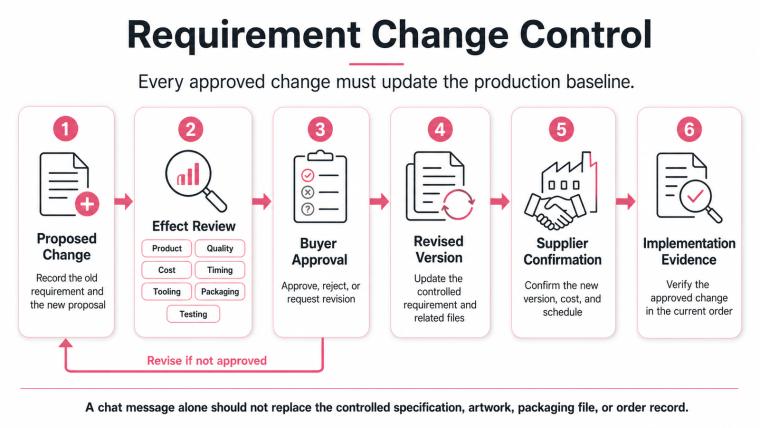
Manage the sourcing timeline through dependencies and gates, not a fixed number of days. The schedule should show what starts each stage, the required approval and supplier evidence, and any issue that could delay the next commitment.
- Decision: Is production still aligned with the approved order?
- Evidence: Milestones, current versions, material and process evidence, measurements, tests, and corrective actions.
- Record: A milestone log and approved change record.
- Stop or delay: Unapproved substitution, missed critical milestone, unresolved process issue, or evidence that cannot be tied to the order.
- Residual risk: Milestone evidence is selective and does not release the finished lot.
11. Inspect before shipment
Plan the inspection against the current controlled requirement, approved sample or reference, packaging and label files, quantity status, and defined checks. Confirm that the goods are ready and accessible and that the inspection team has the correct version.
The result should support a release, rework, recheck, or hold decision. If corrective work is required, define the correction, acceptable evidence, and whether another inspection is needed. A sampled inspection is not a promise about every unit.
The pre-shipment inspection checklist can help organize the release criteria. Payment timing should follow the agreed commercial terms and evidence, but this guide does not prescribe a universal payment split or fixed inspection date.
- Decision: Do the current goods support release, rework, recheck, or hold?
- Evidence: Lot status, controlled criteria, inspection results, packaging and labels, and corrective evidence.
- Record: An inspection report and documented release decision.
- Stop or delay: Goods are incomplete, versions conflict, a critical nonconformity remains, or corrective evidence is insufficient.
- Residual risk: Inspection is sampled and time-bound; transport and hidden defects may remain.
12. Complete the shipping handoff
The shipping gate begins before pickup. Reconcile the product description, quantity, package count, marks, carton dimensions, net and gross weight, commercial invoice, packing list, pickup and consignee details, Incoterm and named place, and logistics instructions. Official trade guidance identifies commercial invoices and packing lists as common documents, while special documents depend on product and destination. 14 Confirm destination-specific needs with the importer, forwarder, customs broker, or official authority.
For multiple suppliers, track each supplier’s goods-ready status, final package data, document readiness, delivery appointment, and effect on the consolidation plan. Use the shipping-documents checklist and consolidation checklist where relevant.
Kelsy Practical Note: the slowest critical supplier controls the gate
Kelsy coordinated an anonymous consolidated shipment to the Maldives involving more than 20 suppliers across Chinese cities from Guangzhou to Hebei. Consolidation and container loading were planned at a Guangzhou warehouse.
One air-conditioning supplier did not deliver on time. The booked shipping slot could not be used, while the other goods remained in the warehouse and generated storage fees. Ocean freight increased during the wait, and replacement space and a container were difficult to secure. The shipment was delayed by approximately three weeks.
The lesson is operational: in a consolidated shipment, the shipping gate depends on the readiness of the slowest critical supplier. A booking should be tied to verified readiness across the critical supply chain, not to the expected date of one supplier in isolation.
- Decision: Can the forwarder, warehouse, and customs chain receive a consistent shipment?
- Evidence: Final goods, package data, documents, bookings, contacts, and every critical supplier’s readiness.
- Record: A shipping handoff pack accepted by the forwarder or warehouse.
- Stop or delay: Documents conflict, required data is missing, a critical supplier is unready, or pickup and consignee details are unconfirmed.
- Residual risk: Customs, transit, damage, freight availability, and destination events remain outside factory control.
13. Use stage gates before every commitment
Nine sourcing stage gates
| Gate | Buyer is deciding | Required record or output | Do not proceed if | Residual risk after passing |
|---|---|---|---|---|
| Ready to contact suppliers | Can suppliers understand and quote the requirement? | Quote-ready requirement pack | Market, quantity, flexibility, or critical requirements are unclear | Suppliers may interpret or price inputs differently |
| Ready to shortlist | Which leads justify deeper work? | Longlist with fit and evidence status | Identity or product fit is inconsistent; material answers are missing | Shortlisted suppliers are not verified |
| Ready to order samples | Which suppliers and samples justify the investment? | Sample request with version and acceptance criteria | Sample basis, fee, timing, or revision path is unclear | Sample may not represent bulk process or capacity |
| Ready to select a supplier | Which supplier supports the product and commercial decision? | Verification summary, normalized quote, sample result, risk note | Capability, offer, sample, or entity evidence remains unresolved | Selection does not ensure future performance |
| Ready to pay the deposit | Is the transaction and payment instruction controlled? | Final order-control pack and beneficiary verification | Contracting party, bank account, requirements, roles, or protection terms conflict | Payment and written terms do not ensure performance or recovery |
| Ready to begin production | Are all release inputs approved? | Production-release authorization | Sample, artwork, packaging, tooling, material, or change approval is open | Production may still deviate or be delayed |
| Ready to inspect | Are goods and criteria ready for a valid decision? | Confirmed lot status, current requirement, inspection plan | Goods are incomplete, version is unclear, or access is restricted | Inspection is sampled and time-bound |
| Ready to pay the balance | Do inspection and correction records support release? | Balance-release decision | Critical nonconformity, shortage, wrong packaging, or corrective work remains | Payment does not control later transport or hidden defects |
| Ready to ship | Can the shipment move with consistent records? | Accepted shipping handoff pack | Documents, product data, pickup, destination requirements, or consolidation readiness conflict | Customs, transit, damage, and destination events remain |
- Decision: Which commercial commitment, if any, may proceed?
- Evidence: The current gate evidence, limitations, and open risks.
- Record: A master gate decision log.
- Stop or delay: Critical evidence, approval, or responsibility remains unresolved.
- Residual risk: Passing a gate supports progression; it does not remove downstream risk.
Kelsy’s role in this process is practical: clarify requirements; compare offers on the same basis; check supplier and payment information; connect sample decisions to production records; request milestone evidence; coordinate inspection; manage supplier readiness and shipping handoff; and stop progression when critical information remains unresolved.