A supplier’s business licence, certificates, quotation, and product sample may all look acceptable. One practical question can still remain unanswered: can the reviewed factory make the required product through a controlled and repeatable process?
The question matters more when the product is customized, the order depends on critical manufacturing processes, capacity is central to the delivery plan, or the supplier’s production arrangements remain unclear. A useful audit starts with the product, the site, the evidence needed, and the buyer’s decision, not with a universal checklist.
This guide covers how to scope and conduct a factory audit, interpret the findings, and use them before supplier approval or production release. It addresses one detailed part of the overall China sourcing process and does not replace the other checks required before and during an order.
1. What a China factory audit is, and what it is not
ISO 19011 describes an audit as a systematic, independent, and documented process for obtaining objective evidence and evaluating it against defined criteria. When a buyer, or someone acting on the buyer’s behalf, audits a potential supplier, that is a second-party audit rather than a certification audit. 1
In this guide, a factory audit is a buyer-directed assessment of the actual production site, processes, resources, controls, and records relevant to a proposed product or order. Its purpose is to establish what the available evidence supports and what remains unverified.
Any conclusion is bounded by the audit objective, scope, date, access, and evidence sample. Audit guidance recognizes that evidence is normally sampled because audit time and resources are finite. 2 Even a clean report does not guarantee the quality, capacity, delivery, legality, or performance of every future order.
The following activities support different decisions:
| Activity | Main decision it supports | What it does not establish by itself |
|---|---|---|
| Factory audit | Whether the reviewed site, systems, processes, and resources support a supplier or production decision | Whether a particular finished shipment is acceptable |
| Supplier verification | Whether the supplier’s identity, documents, background, and commercial claims justify further review | Whether the claimed production capability operates at the site |
| Product inspection | Whether sampled current goods meet defined product, packaging, or order requirements | The supplier’s long-term capability or complete management system |
| Laboratory testing | Whether the submitted item or material has specified characteristics under the test procedure | The condition of all production or the factory’s whole operating system |
ISO’s conformity-assessment guidance treats auditing, inspection, and testing as distinct techniques, although they can be used together. 3 Certification is another distinct activity. A management-system certificate concerns the system and scope named on the certificate; it does not certify the product or prove that the factory can make the buyer’s order. 9
2. When supplier verification is no longer enough
Desk verification is a sensible place to start. Before arranging site work, verify the supplier's identity and documents first. This may clarify the legal entity, business role, certificates, public information, and obvious inconsistencies.
Documents cannot adequately show every condition that may affect the buyer’s decision. Site-level evidence is more useful when the decision involves:
- a customized or tooling-dependent product;
- a critical manufacturing process;
- an order that is operationally difficult to replace;
- an unclear relationship between the sales company and production site;
- a material risk that key processes are outsourced;
- tight tolerances or a high consequence if a process fails;
- a delivery plan that depends on the supplier’s stated capacity;
- previous quality, change-control, or delivery problems;
- a need to approve a supplier or release production against defined conditions.
These factors help determine whether an audit is warranted. They do not mean that every supplier must be audited. A simple, low-risk purchase may not require the same depth as a custom product whose critical functions depend on specific equipment, skills, and controls.
Nor is an audit the right response to every concern. Questions about formal labour practices, environmental compliance, financial statements, regulated-product systems, or legal conclusions may require a different specialist and a separately defined scope.
3. Define the decision before building the checklist
The audit objective should name the decision it is intended to support. Depending on the project, that may be:
- supplier approval;
- approval limited to a named site, line, or process;
- conditional approval;
- readiness for a custom order;
- production release;
- investigation of an existing quality or delivery problem;
- a decision to request specialist assessment.
Once the decision is clear, set the boundaries. State which legal entity and physical site will be reviewed, which products and processes are included, which period and records are relevant, and which buyer documents will serve as audit criteria. The scope should also identify relevant outsourced processes, required access, confidentiality conditions, exclusions, and the competence the auditor needs.
Without clear boundaries, a report may look comprehensive while omitting the process that matters most to the buyer. If that process is essential to the product, the overall score cannot compensate for the missing evidence.
The audit criteria should be specific enough that the report can connect each finding to a requirement. Those criteria may include the buyer’s specifications, drawings, approved procedures, contractual obligations, work instructions, or applicable standards. 1
4. Build the audit scope from the product and risk
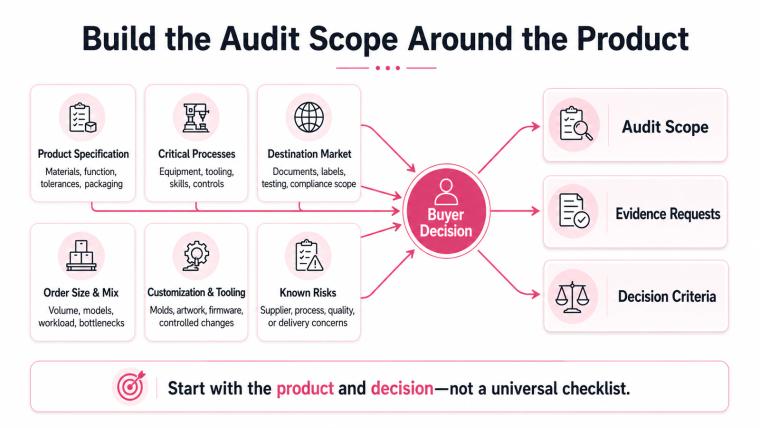
Kelsy customizes the audit scope around the buyer’s product specifications, critical processes, order quantity, customization requirements, and destination market. The broader audit plan should also account for known risks identified during verification, quotation review, sample work, prior orders, complaints, or supplier communication. Six inputs shape the scope:
- Product specification: materials, dimensions, function, tolerances, finish, packaging, and critical-to-quality requirements.
- Critical processes: production steps that require particular equipment, tooling, fixtures, skills, parameters, or environmental controls.
- Destination market: relevant documents, test evidence, labels, product scope, and questions that may require specialist regulatory review.
- Order size and mix: volume, model mix, changeovers, workload, and the processes that may constrain output.
- Customization and tooling: molds, tooling, artwork, materials, firmware, packaging, or other controlled changes.
- Known risks: issues identified during verification, quotation review, sample work, prior orders, complaints, or supplier communication.
The buyer needs clear criteria before the factory can be assessed against them. If the product requirements are still incomplete, prepare clear product requirements before treating the audit as an approval gate.
Keep the scope boundaries visible. Basic observation of working conditions or environmental safety may be included, but it is not a formal social-compliance, labour, environmental-compliance, or legal audit. Ethical and social compliance require competent specialist work or a named scheme. A financial audit belongs with a qualified accounting or audit organization.
The factory audit may review test equipment, test processes, records, and apparent capability. Independent laboratory testing remains separate. Certificates may be checked for authenticity, validity, site or product scope, and relevance, but the factory audit does not issue certification or replace a certification audit.
5. Prepare the evidence before the visit
Reviewing documents in advance helps focus the site visit. Common preliminary documents in Kelsy projects include the supplier’s business licence and available ISO certificates. Depending on the scope, the evidence request may also include:
- the legal entity and site addresses;
- the relationship among the sales company, exporter, licence holder, and production facility;
- a product list, process map, or production flow;
- an equipment and tooling list;
- relevant quality procedures and test records;
- calibration, maintenance, nonconformance, or corrective-action records;
- purchasing and external-provider information;
- a production schedule or workload record relevant to the capacity question;
- the buyer’s specification and priority risks.
Public Chinese enterprise-information platforms can help clarify entity relationships. The National Enterprise Credit Information Publicity System supports searches by enterprise name or unified social credit code. Its help material explains that displayed information comes from government departments and market entities. The result should therefore be read according to its source, not treated as conclusive proof of every operational claim. 4
Certificate review should check the named organization, site, issuer, standard, scope, status, and relevance. China’s certification regulator provides public query channels for certification results, certification bodies, rules, and accreditation information. 5
Each item has limits. A business licence can identify a registered entity, but it does not show that a required process runs at the reviewed site. An equipment list does not prove that the equipment is present, maintained, staffed, or available. A certificate does not prove that the factory can make the buyer’s product. A process map does not prove that the process operates as drawn.
Use the pre-audit documents to identify what must be observed, traced, or challenged during the visit.
6. Follow the real production flow on site
The site review should follow the product’s actual production flow, rather than a standard tour through unrelated departments.
Start with incoming materials. Review how the factory identifies materials, checks incoming items, records status, separates rejected material, and releases material to production. Then follow the relevant manufacturing steps, paying attention to bottleneck equipment, tooling, fixtures, maintenance, staffing, work instructions, and the controls used at each stage.
At quality-control points, compare the stated method with what operators and inspectors actually use. Review in-process and final checks, measurement and test equipment, calibration status, records, and the response to a failed result. The audit trail should connect the requirement, the check, the record, the nonconforming output, and any corrective action.
Purchasing and outsourcing need the same attention. ISO 9001 Auditing Practices Group guidance on external providers discusses purchasing, outsourced processes, provider approval, monitoring, and verification of requirements. 6 The guidance is educational and non-normative, but it provides a useful structure for asking which processes are performed externally and how the factory controls them.
Packaging, labeling, storage, and export handoff may also be reviewed at a capability level. That does not turn the audit into an inspection of the finished shipment.
7. Test whether the system operates in practice
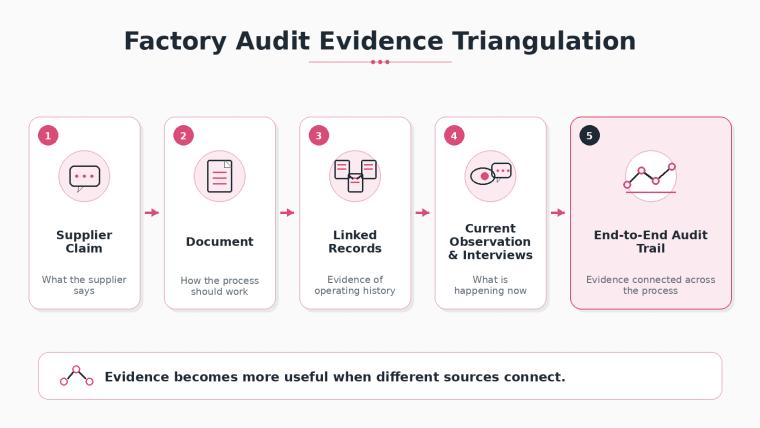
Separate pieces of evidence are more useful when they connect. A supplier statement identifies a claim, while a document may show how the process is supposed to work. Linked records may show a history. Current observation and interviews may then show whether the documented process is operating. An end-to-end audit trail brings these layers together.
Practical triangulation can include:
- tracing one real product or batch from material receipt through production, quality checks, rework, and finished status;
- comparing current floor activity with the process map, production records, and work instructions;
- asking operators which revision applies and what happens when a check fails;
- sampling records across different dates, products, and outcomes rather than relying only on a prepared example;
- reconciling the equipment list with observed machinery, tooling, maintenance, utilities, and actual use;
- following a nonconformance through identification, segregation, disposition, cause, action, and verification;
- comparing incoming-material records with warehouse status and production use;
- checking whether subcontracting records align with the processes missing from the site.
Capacity calls for the same kind of triangulation. Kelsy considers production-line equipment configuration and staffing rather than relying only on a stated monthly output. The project may also require attention to bottlenecks, available hours, product mix, changeovers, yield, downtime, current workload, and external processes. These inputs support a bounded capacity assessment; they do not guarantee future output or delivery.
Sampling method varies by project. It may include auditor-selected records, machines, batches, or samples drawn from supplier-prepared information. There is no universal record or machine count. If the supplier refuses to show an area, process, record, or subcontractor, Kelsy records the limitation rather than treating the item as verified.
8. On-site, remote, or hybrid
Remote methods can support document pre-review, preliminary interviews, selected video evidence, and corrective-action follow-up. They may reduce unnecessary site time when the required evidence can be assessed reliably, but they have important limits.
ISO/IEC TS 17012 states that remote auditing methods are not intended to replace on-site audit methods. 7 ISO 19011 recognizes that remote and on-site methods can be combined. 1 The choice should follow the audit objective rather than convenience alone.
Remote work gives the host more control over the camera path, the records shown, and the surrounding context. Connection quality, technology, data security, confidentiality, recording permission, and access to paper or system records can affect what the auditor can verify. IAF guidance for formal ICT-supported audit and assessment work emphasizes planning for integrity, security, confidentiality, infrastructure, competence, and risks to the validity and objectivity of evidence. 8
A hybrid sequence may begin with remote document review, followed by targeted on-site work for physical evidence and critical processes. Suitable corrective-action evidence can then be reviewed remotely. A targeted on-site re-audit may still be necessary when the correction depends on physical implementation.
Kelsy treats on-site work as necessary or materially more appropriate for customized products, critical manufacturing processes, and larger orders. The method still varies by project, and no remote review should be described as equivalent to an on-site audit.
9. Read the report without over-trusting the score
Start with the audit scope, audit criteria, site, date, exclusions, and access limitations. Read each load-bearing finding before looking at the overall score.
A well-structured finding connects:
- the criterion or requirement;
- the evidence reviewed;
- what was observed or not verified;
- the affected product, process, or site;
- the risk or decision significance;
- the next action and verification method.
Kelsy reports may include Pass, Conditional Pass, or Fail; a score or percentage; Critical, Major, or Minor labels; risk notes; corrective recommendations; and deadlines. These fields can help organize the report, but none is a universal standard. Criteria, weighting, severity, deadlines, and decision rules depend on the project and defined scope.
One load-bearing finding may matter more than an average percentage. A factory may score well across general administration and housekeeping while failing to show the equipment or process required for the buyer’s product. Equally, an unavailable record should not be converted into a pass. “Not verified” describes an evidence limit, not a successful result.
The buyer remains responsible for the decision. The report supports that decision; the score does not make it automatically.
10. Choose the next action
Choose the next step according to the finding, its significance, and the evidence needed to close it.
| Audit result or evidence state | Possible buyer action | What should be defined |
|---|---|---|
| Evidence supports the scoped requirements | Proceed | Preserve the report limits and continue normal sample, order, and inspection controls |
| Bounded gaps can be controlled | Proceed with conditions | Written condition, owner, due point, and release gate |
| A claim remains unverified | Request evidence | Exact record, demonstration, verification, or test required |
| A load-bearing process or control is inadequate | Corrective action before release | Correction, cause, action, owner, deadline, and verification method |
| Physical implementation or prior evidence needs confirmation | Targeted re-audit | Named finding, process, site, and evidence to re-check |
| Capability appears plausible but consistency remains uncertain | Trial order | Specific approval conditions and tighter production, testing, or inspection controls |
| Critical evidence is absent or risk remains unacceptable | Hold or reject approval | Criterion, evidence gap, unresolved risk, and decision record |
| The issue is outside the general audit scope | Specialist referral | Named legal, social, environmental, financial, laboratory, certification, or sector scope |
Corrective-action follow-up also varies. Depending on the finding, suitable evidence may include documents, photographs, video, targeted remote review, or an on-site re-audit. Kelsy’s verification method depends on the severity and nature of the finding; there is no fixed deadline or follow-up rule.
11. Carry audit findings into the order
An audit has limited value if the findings stay in the report while the order continues unchanged.
First, approve the product sample separately. Record whether the sample was produced using the audited site, process, materials, and tooling. A capable factory does not make every sample acceptable, and an acceptable sample does not prove scalable factory capability.
Next, transfer relevant conditions into the purchase-order and production-release records. These may identify the approved production site, required evidence, open corrective actions, permitted subcontracting, change-notification requirements, or a release hold point. The wording depends on the project and agreement.
During an active order, track the identified risks during production. Monitoring can focus on the processes, materials, external providers, changes, or corrective actions that the audit showed were important.
Keep product testing and shipment inspection separate. Obtain relevant laboratory evidence where product characteristics require it, and inspect the actual goods before shipment against the approved product and order requirements. A factory audit supports supplier and process decisions; it does not release the finished lot.
Carry unresolved findings into supplier monitoring. Complaints, delivery performance, changes, corrective-action effectiveness, and new risk signals can change the next review decision. That decision should be based on risk and specific triggers, not a universal re-audit interval.
12. Final factory-audit decision check
Before approving the supplier or releasing production, confirm:
- the audit objective and buyer decision were defined;
- the correct legal entity, production site, product, and processes were in scope;
- the criteria came from the current product and order requirements;
- critical processes, equipment, staffing, controls, and outsourced work were addressed;
- important claims were supported by linked and verifiable evidence;
- access restrictions and unverified items are visible;
- specialist questions were referred rather than overstated;
- load-bearing findings were reviewed independently of the average score;
- conditions, corrective actions, owners, and verification methods are recorded;
- audit findings have been carried into the sample, order, production, testing, inspection, and monitoring plan.
If the scope or evidence cannot support the intended decision, the answer is not automatically "pass" or "fail." It may be a narrower approval, a condition, an evidence request, a targeted re-audit, or a specialist referral. The audit should make that next decision explicit.
For project-specific support, you can request a scoped factory audit built around the product, site, processes, and evidence required.