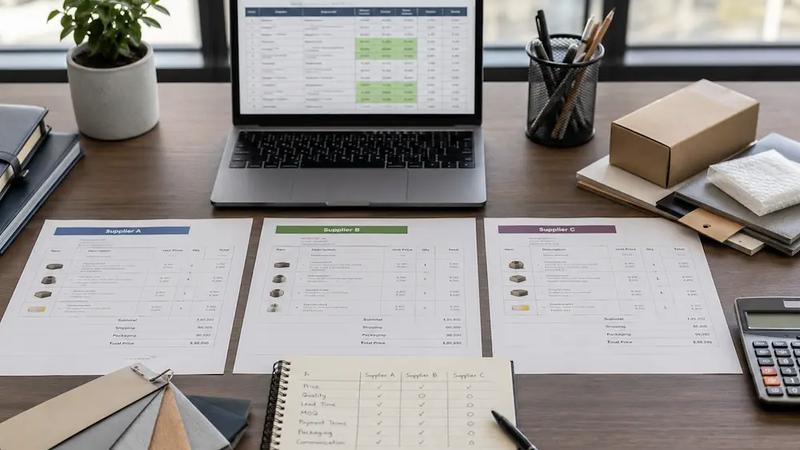
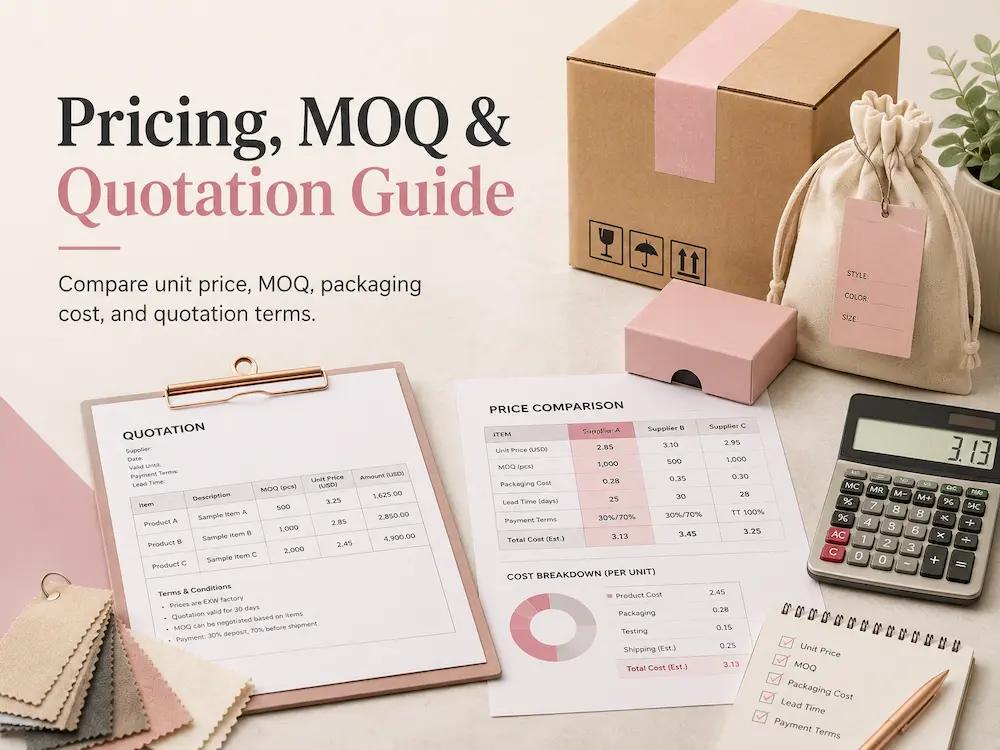
Two quotations can show the same product photo and still be pricing different orders. One supplier may use a different material. Another may exclude retail packaging, testing, or domestic transport. A third may quote EXW while the others quote FOB.
Start by putting every supplier on the same basis: the same specification, quantity, packaging, customization, and delivery term. A lower unit price does not automatically mean a lower total cost, especially when one-time charges or excluded services appear later.
This guide explains how China supplier pricing and MOQ are formed, what a usable quotation should contain, and what to ask when details are missing. It cannot guarantee a particular price or supplier outcome, but it can help you see when quotations are not ready to compare.
Why China Supplier Prices Can Be Different
A supplier calculates price from the version of the order it believes you want. If your request leaves room for interpretation, each supplier may fill the gaps differently.
- Materials, components, and product grades may differ even when the finished products look similar.
- Dimensions, functions, finishes, tolerances, and included accessories change material use and production work.
- Order quantity, packaging, labeling, and quality-control requirements affect setup time and cost per unit.
- Incoterms, payment terms, lead time, and available production capacity change what the supplier must fund or arrange.
- A factory, trading company, and specialist supplier may include different levels of sample work, customization support, inspection coordination, and production follow-up.
Price differences are useful only after you identify their cause. If specifications or quotation terms differ, ask for revised quotations before ranking suppliers.
What MOQ Really Means
MOQ means minimum order quantity. It is the smallest order a supplier is prepared to accept under a specific set of product and commercial requirements. It is not always an arbitrary sales number.
- Production MOQ can come from raw-material purchases, component batches, machine setup, labor setup, or the supplier's inventory policy.
- Customization MOQ may be driven by logo printing, custom color, special material, molding, or tooling requirements.
- Packaging MOQ often comes from a separate printer or packaging factory, not the product manufacturer.
Ask for the standard-product MOQ first, then ask how the MOQ changes for your logo, color, material, size, and packaging. A supplier may accept 500 standard products while its box printer requires 1,000 printed boxes. In that case, confirm who pays for the unused boxes, where they will be stored, and whether they can be used for a later order.
What Affects Unit Price
Unit price starts with the product specification. Material grade, component quality, dimensions, finish, production difficulty, and quality requirements all change the cost before packaging or freight is considered.
- Order volume affects how setup cost is spread across the order. Logo printing, custom colors, dimensions, materials, molds, and tooling add their own setup or production costs.
- Retail boxes, inserts, manuals, labels, barcodes, accessories, and spare parts can be included in the unit price or charged separately.
- Testing, certification support, stricter inspection requirements, and an urgent lead time may increase the quoted cost.
- Raw-material and exchange-rate changes can shorten quotation validity or cause a supplier to recheck price before an order is confirmed.
Ask which product, quantity, packaging, customization, lead-time, payment, and delivery assumptions were used. If an assumption is not written down, it is not yet safe to use in your comparison.
What a Supplier Quotation Should Include
A usable quotation should let another person understand what is being sold and on what terms. A product photo and unit price are not enough.
- Product name, model number, specification, material, size, color, finish, and included accessories
- Unit price, currency, quantity basis, MOQ, quotation validity, and any price tiers
- Sample price, sample lead time, production lead time, and the event that starts the production clock
- Packaging details, logo and customization charges, mold or tooling costs, and other one-time fees
- Payment terms, Incoterm, named port or place, shipment handoff point, and included or excluded transport charges
- Supplier company name, contact details, quotation date, and quotation reference number where available
If any of these details are missing, ask for an updated quotation or written clarification before payment. Do not rely on an assumption because it seems standard.
How MOQ, Unit Price, and Customization Affect Each Other
A smaller order often carries a higher unit price because setup work is divided across fewer pieces. A larger order may reduce unit cost, but it also increases inventory, cash-flow, and demand risk. The lower unit price is useful only if you can sell or use the additional stock.
Standard products and neutral packaging often allow a smaller trial order. A logo, custom color, special material, new dimensions, private-label box, or mold can change both MOQ and price. Sample charges should stay separate from mass-production pricing, and tooling or setup fees should be shown as one-time costs where possible.
A simple cost example
The following figures are illustrative, not real supplier offers. Suppose an order is 500 units at USD 4.20 each, with an USD 80 logo setup fee, USD 250 testing cost, and 1,000 printed boxes at USD 0.45 each because the box printer will not produce 500.
The immediate commitment is 500 × USD 4.20 + USD 80 + USD 250 + 1,000 × USD 0.45 = USD 2,880. Allocated across the first 500 products, that is USD 5.76 per unit before international freight, duty, tax, customs clearance, or local delivery.
This is why buyers should compare the cash required for the order as well as the quoted unit price. Ask whether unused packaging is included in the shipment, stored for a later order, or charged separately.
How Packaging Changes Price and MOQ
Packaging is part of the product requirement, not a detail to settle after choosing a supplier. Neutral packaging may use stock materials. Printed retail packaging usually needs artwork, color matching, printing setup, and a separate minimum order.
- Confirm whether the price includes a neutral inner pack, individual box, printed retail box or color box, insert, manual, barcode, and warning label.
- Confirm shipping-carton dimensions, carton quantity, carton marks, pallet requirements, and any destination-specific label instructions.
- For private-label packaging, ask for the packaging MOQ, unit cost, printing or plate fees, artwork requirements, production time, and approval process.
A small product order can still require a larger packaging purchase. Put the treatment of unused packaging in writing: quantity, ownership, payment, storage period, storage conditions, and what happens if the artwork or product changes before the next order.
How Incoterms Change the Quoted Price
Incoterms define delivery responsibilities, costs, and risk between buyer and seller. They do not replace the sales contract or specify product quality and payment terms. Use the three-letter term with a precise named port or place and the applicable version, such as Incoterms® 2020. The International Chamber of Commerce publishes the official rules.
EXW
EXW usually prices delivery at the supplier's factory, warehouse, or another named place. The seller is not required to load the collecting vehicle or clear the goods for export. The buyer should identify domestic pickup, loading, export handling, freight, and destination costs before comparing EXW with another term.
FOB
FOB is for sea or inland waterway transport. The seller delivers the goods on board the vessel at the named port of shipment and handles export clearance. Confirm the exact port and included origin charges; a quotation that says only "FOB China" is incomplete.
CIF
CIF is also for sea or inland waterway transport. The seller arranges freight and insurance to the named destination port, but risk transfers when the goods are on board the vessel at the port of shipment. Destination charges, customs clearance, duty, tax, and local delivery may still be outside the quoted price.
DDP
Under DDP, the seller is responsible for delivering the goods, cleared for import, to the named destination and ready for unloading. Confirm the precise delivery point, duty and tax treatment, customs arrangements, unloading responsibility, delivery limits, and whether the seller can lawfully complete import clearance in the destination country.
Do not compare EXW and DDP totals as if they include the same work. First identify what each price covers, then add the costs you will bear outside the supplier's quotation.
Payment Terms and Quotation Risk
Payment terms affect cash flow and your ability to resolve open questions before shipment. Write down the deposit percentage, payment currency, bank charges, and the event that triggers the balance payment.
- Clarify whether the balance is due after production, after inspection, before shipment, against shipping documents, or at another agreed point.
- Compare the beneficiary name and bank details with the supplier company, quotation, and proforma invoice. Investigate a mismatch or sudden account change before sending money.
- Pause when you are pressured to pay before specifications and commercial terms are documented. Unusually favorable payment terms also need a clear written basis.
The final payment schedule, beneficiary, product requirements, quantity, price, and delivery basis should appear in the PI or order agreement. A chat message is useful context, but it should not be the only record of an important term.
Pricing, MOQ & Quotation Review Table
Work through this table before deciding which quotation is cheaper. A blank or vague answer is a question to send back to the supplier.
| Check Item | What to Confirm | Why It Matters |
|---|---|---|
| Product specification | Model, size, material, function, color, finish, and technical details | Prices are only comparable when product requirements are the same |
| Unit price | Currency, order quantity, price basis, and quotation validity | Prevents comparison of different pricing assumptions |
| MOQ | Standard product MOQ, logo MOQ, packaging MOQ, and custom MOQ | Different types of customization may have different minimums |
| Packaging | Inner box, retail box, carton, label, insert, manual, and barcode | Packaging can affect both price and MOQ |
| Customization | Logo, color, material, size, mold, tooling, and private label | Custom work may add cost, setup time, and minimum quantities |
| Sample | Sample cost, shipping cost, and sample lead time | Sample terms may differ from mass-production terms |
| Lead time | When production time starts and whether packaging time is included | Prevents misunderstanding of the shipment schedule |
| Incoterms | EXW, FOB, CIF, DDP, named port, or named destination | Delivery responsibility changes the real total cost |
| Payment terms | Deposit, balance, payment trigger, and beneficiary details | Payment structure affects both risk and cash flow |
| Inspection | Whether inspection is allowed before balance payment and shipment | Important quality-control arrangements should be confirmed early |
| Missing details | Any item not clearly stated in the quotation | Unclear details should be confirmed before supplier selection |
When several suppliers respond, place their answers side by side. The supplier quotation comparison guide explains how to normalize those replies before choosing a supplier.
Common Quotation Red Flags
A low price is not proof of fraud. It may reflect a different product, inventory position, production method, or commercial goal. The concern is an unusual difference that the supplier cannot explain clearly.
- The price is far below other quotations, product specifications are missing, or the quotation appears copied from an unrelated product.
- MOQ is absent or changes without explanation, and packaging or customization is promised without confirming its cost or minimum quantity.
- The Incoterm, named port or destination, packaging basis, or production lead time is missing.
- Price or major terms change during the deposit discussion without a product, quantity, cost, or timing explanation.
- The bank account does not match the expected beneficiary, changes suddenly, or the supplier pressures you to pay immediately.
- The supplier refuses to confirm details in writing or overpromises on customization, quality, or delivery without asking practical questions.
What to Confirm Before Accepting a Quotation
Use one final written check before accepting a quotation or paying a deposit. The aim is to turn a sales quote into a clear order basis.
- Final product specification, materials, components, approved sample or reference, quantity, and each applicable MOQ
- Unit price, currency, quantity basis, quotation validity, and every included or excluded cost
- Packaging, logo, labels, manuals, barcode, carton marks, and treatment of unused custom packaging
- Sample approval status, production lead time, when that lead time starts, and whether packaging time is included
- Incoterm, named port or destination, shipment handoff point, inspection arrangement, and required documents
- Deposit, balance-payment trigger, payment currency, bank charges, beneficiary name, and verified account details
- A PI or order confirmation that records the final product and commercial terms
A message you can send to the supplier
Please revise your quotation based on the attached product requirements and confirm the following points:
- Product specifications and materials, unit prices at the requested quantity tiers, and quotation validity
- Product, logo, and packaging MOQ, plus packaging specifications and customization charges
- Tooling, setup, testing, and other one-time charges, sample terms, and production lead time
- Payment terms, Incoterm, named port or place, and any excluded costs
If your quotation uses a different specification, quantity, packaging, or delivery basis, please mark the difference clearly.
When to Ask for Help
Ask for help when the missing information prevents a clean comparison, not simply because suppliers use different quotation formats.
- Several quotations use different specifications, MOQ definitions, packaging assumptions, customization charges, or Incoterms.
- One price is much lower than the others and you cannot identify what is included or excluded.
- You need a cleaner comparison of cost, inventory commitment, delivery responsibility, or payment terms before paying a deposit.
A quotation review can identify gaps and questions. It cannot remove every sourcing risk or replace product testing, supplier verification, a clear order agreement, and suitable inspection planning.